
| TYPE | RADIO BLACKOUT | SOLAR STORM | GEO STORM |
|---|---|---|---|
| SCALE | 1-2: 1%, 3-5: 10% | 20% | 1 |
| TEXT | None | S1 or < | minor |
| TYPE | RADIO BLACKOUT | SOLAR STORM | GEO STORM |
|---|---|---|---|
| SCALE | 0 | 0 | 0 |
| TEXT | none | none | none |
| TYPE | RADIO BLACKOUT | SOLAR STORM | GEO STORM |
|---|---|---|---|
| SCALE | 1-2: 1%, 3-5: 1% | 20% | 1 |
| TEXT | None | S1 or < | minor |
:Product: 3-Day Forecast
:Issued: 2026 Sep 15 0030 UTC
# Prepared by the U.S. Dept. of Commerce, NOAA, Space Weather Prediction Center
#
A. NOAA Geomagnetic Activity Observation and Forecast

The greatest observed 3 hr Kp over the past 24 hours was 4 (below NOAA
Scale levels).
The greatest expected 3 hr Kp for Sep 15-Sep 17 2026 is 4.67 (NOAA Scale
G1).

NOAA Kp index breakdown Sep 15-Sep 17 2026

             Sep 15       Sep 16       Sep 17
00-03UT       3.33         3.67         3.67
03-06UT       4.67 (G1)    3.33         3.00
06-09UT       3.33         3.00         2.00
09-12UT       3.67         2.67         2.67
12-15UT       3.00         3.00         2.67
15-18UT       3.00         3.33         2.67
18-21UT       3.00         3.67         2.00
21-00UT       3.00         4.67 (G1)    2.67

Rationale: G1 (Minor) geomagnetic storms are likely on 15-16 Sep due to
the CH HSS effects combined with CMEs glancing blow.

B. NOAA Solar Radiation Activity Observation and Forecast

Solar radiation, as observed by NOAA GOES-18 over the past 24 hours, was
below S-scale storm level thresholds.

Solar Radiation Storm Forecast for Sep 15-Sep 17 2026

              Sep 15  Sep 16  Sep 17
S1 or greater   20%     20%     20%

Rationale: There is a slight chance for S1 (Minor) solar radiation
storms on 15-17 Sep period.

C. NOAA Radio Blackout Activity and Forecast

No radio blackouts were observed over the past 24 hours.

Radio Blackout Forecast for Sep 15-Sep 17 2026

              Sep 15        Sep 16        Sep 17
R1-R2           10%           10%           10%
R3 or greater    1%            1%            1%

Rationale: There is a slight chance for R1-R2 (Minor-Moderate) radio
blackouts on 15-17 Sep period.
Updated last 2026/09/15 08:35 UTC
-------------------
Product ID: K04A
Issued: 2026-09-14 18:02:37.693
Message Follows:
Space Weather Message Code: ALTK04
Serial Number: 2683
Issue Time: 2026 Sep 14 1802 UTC
ALERT: Geomagnetic K-index of 4 \nThreshold Reached: 2026 Sep 14 1743 UTC\nSynoptic Period: 1500-1800\nActive Warning: YES\nComment:
NOAA Space Weather Scale descriptions can be found at
www.swpc.noaa.gov/noaa-scales-explanation
Potential Impacts: Area of impact primarily poleward of 65 degrees Geomagnetic Latitude.
Induced Currents - Weak power grid fluctuations can occur.
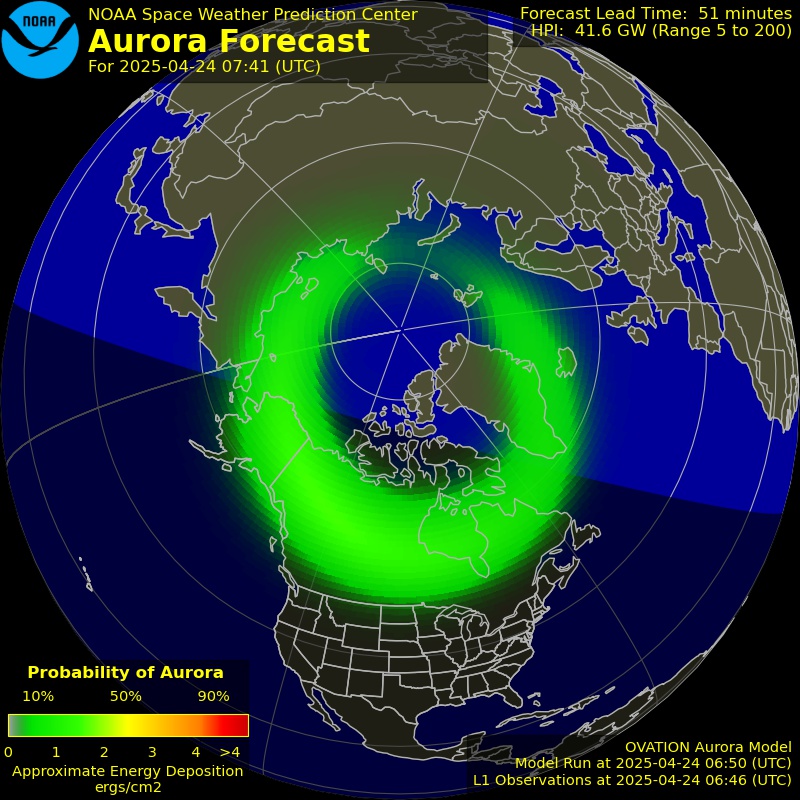
Aurora - Aurora may be visible at high latitudes such as Canada and Alaska.
-------------------
Product ID: K04W
Issued: 2026-09-14 16:54:02.200
Message Follows:
Space Weather Message Code: WARK04
Serial Number: 5416
Issue Time: 2026 Sep 14 1654 UTC
WARNING: Geomagnetic K-index of 4 expected \nValid From: 2026 Sep 14 1653 UTC\nValid To: 2026 Sep 14 2349 UTC\nWarning Conditions: Onset\nComment:
NOAA Space Weather Scale descriptions can be found at
www.swpc.noaa.gov/noaa-scales-explanation
Potential Impacts: Area of impact primarily poleward of 65 degrees Geomagnetic Latitude.
Induced Currents - Weak power grid fluctuations can occur.
Aurora - Aurora may be visible at high latitudes such as Canada and Alaska.
-------------------
Product ID: A20F
Issued: 2026-09-14 15:47:26.890
Message Follows:
Space Weather Message Code: WATA20
Serial Number: 1124
Issue Time: 2026 Sep 14 1547 UTC
WATCH: Geomagnetic Storm Category G1 Predicted \nHighest Storm Level Predicted by Day:\nSep 15: G1 (Minor) Sep 16: G1 (Minor) Sep 17: None (Below G1) \nTHIS SUPERSEDES ANY/ALL PRIOR WATCHES IN EFFECT\nComment:
NOAA Space Weather Scale descriptions can be found at
www.swpc.noaa.gov/noaa-scales-explanation
Potential Impacts: Area of impact primarily poleward of 60 degrees Geomagnetic Latitude.
Induced Currents - Weak power grid fluctuations can occur.
Spacecraft - Minor impact on satellite operations possible.
Aurora - Aurora may be visible at high latitudes, i.e., northern tier of the U.S. such as northern Michigan and Maine.
-------------------
Product ID: EF3A
Issued: 2026-09-14 11:03:04.607
Message Follows:
Space Weather Message Code: ALTEF3
Serial Number: 3744
Issue Time: 2026 Sep 14 1103 UTC
CONTINUED ALERT: Electron 2MeV Integral Flux exceeded 1,000pfu\nContinuation of Serial Number: 3743\nBegin Time: 2026 Sep 10 1304 UTC\n\nYesterday Maximum 2MeV Flux: 1827 pfu\nMax time: 2026 Sep 13 1800 UTC
-------------------
Product ID: EF3A
Issued: 2026-09-13 08:27:29.123
Message Follows:
Space Weather Message Code: ALTEF3
Serial Number: 3743
Issue Time: 2026 Sep 13 0827 UTC
CONTINUED ALERT: Electron 2MeV Integral Flux exceeded 1,000pfu\nContinuation of Serial Number: 3742\nBegin Time: 2026 Sep 10 1304 UTC\n\nYesterday Maximum 2MeV Flux: 1828 pfu\nMax time: 2026 Sep 12 1615 UTC
-------------------
Product ID: EF3A
Issued: 2026-09-12 06:45:35.603
Message Follows:
Space Weather Message Code: ALTEF3
Serial Number: 3742
Issue Time: 2026 Sep 12 0645 UTC
CONTINUED ALERT: Electron 2MeV Integral Flux exceeded 1,000pfu\nContinuation of Serial Number: 3741\nBegin Time: 2026 Sep 10 1304 UTC\n\nYesterday Maximum 2MeV Flux: 7008 pfu\nMax time: 2026 Sep 11 1355 UTC
-------------------
Product ID: EF3A
Issued: 2026-09-11 05:01:52.037
Message Follows:
Space Weather Message Code: ALTEF3
Serial Number: 3741
Issue Time: 2026 Sep 11 0501 UTC
CONTINUED ALERT: Electron 2MeV Integral Flux exceeded 1,000pfu\nContinuation of Serial Number: 3740\nBegin Time: 2026 Sep 10 1304 UTC\n\nYesterday Maximum 2MeV Flux: 1391 pfu\nMax time: 2026 Sep 11 0455 UTC
-------------------
Product ID: EF3A
Issued: 2026-09-11 00:45:33.580
Message Follows:
Space Weather Message Code: ALTEF3
Serial Number: 3740
Issue Time: 2026 Sep 11 0045 UTC
CONTINUED ALERT: Electron 2MeV Integral Flux exceeded 1,000pfu\nContinuation of Serial Number: 3739\nBegin Time: 2026 Sep 10 1304 UTC\n\nYesterday Maximum 2MeV Flux: 3080 pfu\nMax time: 2026 Sep 10 1745 UTC
-------------------
Product ID: EF3A
Issued: 2026-09-10 13:06:18.310
Message Follows:
Space Weather Message Code: ALTEF3
Serial Number: 3739
Issue Time: 2026 Sep 10 1306 UTC
ALERT: Electron 2MeV Integral Flux exceeded 1,000pfu \nThreshold Reached: 2026 Sep 10 1304 UTC\nStation: GOES-19\nComment: Yesterday's max: 1037 pfu\n
-------------------
Product ID: A30F
Issued: 2026-09-09 21:01:32.307
Message Follows:
Space Weather Message Code: WATA30
Serial Number: 282
Issue Time: 2026 Sep 09 2101 UTC
CANCEL WATCH: Geomagnetic Storm Category G2 Predicted \nCancel Serial Number: 281\nOriginal Issue Time: 2026 Sep 08 1702 UTC\nCancelled Level Predicted:\nSep 08 : None (Bellow G1) Sep 09 : None (Bellow G1) Sep 10 : None (Bellow G1) \nConditions no longer warrant watch criteria.
NOAA Space Weather Scale descriptions can be found at
www.swpc.noaa.gov/noaa-scales-explanation
Potential Impacts: Area of impact primarily poleward of 55 degrees Geomagnetic Latitude.
Induced Currents - Power grid fluctuations can occur. High-latitude power systems may experience voltage alarms.
Spacecraft - Satellite orientation irregularities may occur; increased drag on low Earth-orbit satellites is possible.
Radio - HF (high frequency) radio propagation can fade at higher latitudes.
Aurora - Aurora may be seen as low as New York to Wisconsin to Washington state.
-------------------
Product ID: EF3A
Issued: 2026-09-09 05:38:36.473
Message Follows:
Space Weather Message Code: ALTEF3
Serial Number: 3738
Issue Time: 2026 Sep 09 0538 UTC
CONTINUED ALERT: Electron 2MeV Integral Flux exceeded 1,000pfu\nContinuation of Serial Number: 3738\nBegin Time: 2026 Sep 08 1550 UTC\nYesterday Maximum 2MeV Flux: 1003 pfu\nCORRECTED
Current 2026 Sep 14 1205 UTC
Solar-terrestrial indices for 13 September follow.
Solar flux 114 and estimated planetary A-index 6.
The estimated planetary K-index at 1200 UTC on 14 September was 2.00.
No space weather storms were observed for the past 24 hours.
No space weather storms are predicted for the next 24 hours.
Official Space Weather Advisory issued by NOAA Space Weather Prediction Center
Boulder, Colorado, USA
SPACE WEATHER ADVISORY OUTLOOK #26-36
2026 September 13 at 7:21 p.m. MDT (2026 September 14 0121 UTC)
**** SPACE WEATHER OUTLOOK ****
Summary For September 7-13
Solar activity was at low levels for 07-10 Sep and 12-13 Sep, and was at very low levels on 11 Sep. The largest flare of the period was a C5.8/Sf at 12/1720 UTC from Region 4521 (N09, L=266, class/area Hsx/90 on 06 Sep). This region was responsible for the majority of the C-flaring activity, producing 6 of the observed 15. The remainder were produced by Regions 4524 (N12, L=225, class/area Cao/100 on 06 Sep) and 4528 (S11, L=187, class/area Hsx/120 on 08 Sep).
There were 4 CMEs this period. 3 of these were due to filament eruptions. First was a filament eruption associated with a C3.4/1f at 09/0908 UTC from Region 4524, whose slow CME first became visible in STEREO coronagraph imagery at ~09/1623 UTC and in LASCO C3 at ~09/2106 UTC. Modeling indicated a possible glancing blow on 14 Sep. Second, a filament centered around approximately S15W30 began erupting at ~10/0330 UTC, with an associated slow CME first becoming visible in LASCO C2 at ~10/0524 UTC and GOES CCOR1 at ~10/0730 UTC. Modeling indicated the majority of the material would likely pass ahead and below of Earth orbit, however there was the potential for this eruption also produce a very minor glancing blow on 14 Sep. Third was an 8 degree long filament at roughly disk center that began erupting at ~13/1900 UTC, producing a long duration C1.4 at 13/1945 UTC and an associated CME that first became visible in LASCO C2 at ~13/1948 UTC and SOLAR1 CCOR2 at ~13/2030 UTC. Modeling indicated a possible glancing blow on 17 Sep.
Lastly, a very slow CME first became visible in LASCO C2 at ~12/1612 UTC and in STEREO at ~12/1638 UTC. Despite triangulation with STEREO indicating a front-sided eruption, no clear source was found except for perhaps some faint coronal dimming in the SW quadrant in GOES/SUVI 195. Modeling indicated the material would pass below Earth orbit.
The greater than 10 MeV proton flux at geosynchronous orbit was slightly elevated on 07 Sep due to the continued recovery from the 05 Sep S1 event, but was at background levels for the majority of the reporting period.
The greater than 2 MeV electron flux at geosynchronous orbit was at normal-moderate levels on 07 Sep and at high levels on 08-13 Sep.
Geomagnetic activity reached active levels and a few isolated periods of G1 (Minor) storming conditions on 08 Sep due to positive polarity coronal hole high speed stream (CH HSS) influences, potentially with embedded effects from CMEs that left the Sun on either 04 Sep or 06 Sep. The remainder of the reporting period, 09-13 Sep, was at quiet to unsettled levels.
Outlook For September 14-20
Solar activity is expected to be at low levels, with a slight chance for moderate to high levels throughout the forecast period.
Not proton events are expected at geosynchronous orbit.
The greater than 2 MeV electron flux at geosynchronous orbit is expected to be at high levels on 14 Sep, 16-23 Sep, 27 Sep-03 Oct, and 05-10 Oct. Levels are expected to be at normal-moderate levels on 15 Sep, 24-16 Sep, and 04 Oct.
Geomagnetic field activity is expected to reach active to G1 storming levels on 14-17 Sep due to negative polarity CH HSS effects with the potential for CME influence from a CME that left the Sun on 09 Sep; 24-27 Sep due to positive polarity CH HSS influences; and unsettled to active levels on 05-08 Oct due to positive polarity CH HSS influences. Largely quiet levels are anticipated for all remaining dates in the forecast period.